For years, brands have optimized for being found. Higher rankings, better ads, stronger marketplace visibility, cleaner product feeds, more content, more reach. All of that still matters.
But the next visibility layer is different.
When customers ask AI systems for advice, comparison or recommendations, brands are no longer only competing for attention. They are competing for interpretation. Can an AI system understand what your product is? Can it explain who it is for? Can it recognize the proof behind your claims? Can it recommend you in the right context? Can it avoid saying things your brand would never approve?
The new visibility problem is not only: can customers find us? It is: can AI understand us well enough to recommend us responsibly?
LLM visibility is not just the next version of SEO
LLM visibility means that AI systems can discover, understand, verify and represent a brand or product correctly in answers, comparisons and recommendations. That sounds close to search visibility, but it is not the same thing. Search visibility is often about being found. LLM visibility is about being interpreted.
A brand can rank well, advertise well and distribute well — and still be misunderstood by AI systems if its product data, claims, FAQs, reviews, service promises and content signals are inconsistent.
This is where the next commercial risk begins. Many companies still treat agentic commerce as a future checkout topic. They wait for autonomous purchasing, embedded payments or full agent-to-agent transactions to become mainstream. That view is too narrow. The more immediate shift is happening much earlier in the journey: in discovery, comparison, explanation and shortlisting.
Agentic commerce is not only a checkout story. It is a visibility and interpretation story.
The new competition is semantic trust
If an AI shopping assistant compares products, summarizes benefits or recommends one option over another, it needs more than keywords. It needs structured, consistent and trustworthy information. It needs to understand what the product is, who it is for, when it is relevant, why it is different, what proof supports the claim and when it should not be recommended.
This is where many brands are not ready. They may have strong visuals, beautiful campaigns and emotional storytelling. But their product data, claims, FAQs, marketplace content, reviews, product pages and paid media messages often tell slightly different stories. For human users, that may still work. People can tolerate gaps, contradictions and implied meaning. AI systems are less forgiving. They interpret what is available, connect signals and fill gaps where context is missing.
For brands, that creates a new kind of representation risk. If the information is unclear, inconsistent or unsupported, AI systems may ignore the brand, flatten its differentiation or infer things the company would never want to say.
The next visibility problem in commerce is not only SEO. It is semantic trust.
The Machine-Readable Trust Framework has five layers
From a CMO and commercial leadership perspective, I would look at LLM visibility through five layers: product clarity, usage context, proof, inference boundaries and measurement. Together, they form the Machine-Readable Trust Framework.
Product Clarity
Can AI systems understand what the product actually is? This includes attributes, ingredients, materials, sizes, certifications, compatibility, availability, price logic and basic product facts. A product feed that works for classic shopping ads is not automatically ready for AI-mediated discovery. AI systems need enough structure to understand not only that a product exists, but what it does, how it differs and where it fits.
Usage Context
Can AI systems understand when, why and for whom the product is relevant? Many product pages describe features, but fewer explain use cases, occasions, suitability, limitations and trade-offs clearly enough for AI systems to interpret. A skincare product is not just "hydrating"; it may be relevant for dry skin, seasonal use or a specific routine step. A fashion product is not just "premium"; it may be suitable for workwear, travel or occasion dressing. If the usage context is missing, AI systems will either ignore the product or infer context on their own. Both are risky.
Proof
Can AI systems understand why a claim should be trusted? Words like "premium", "clean", "sustainable", "high-performance" or "science-backed" are not enough. Brands need to connect claims with evidence: certifications, ingredients, materials, reviews, expert validation, test results, origin, warranty, compliance or customer feedback. Trust signals become especially important when AI systems compare alternatives. A vague claim is easy to flatten. A supported claim is easier to represent correctly.
Inference Boundaries
Is it clear what AI should not say? Brands need a clear view of unsupported claims, sensitive wording, category restrictions and areas where AI should not infer too much. No unsupported beauty claims. No medicalized promises. No unverified sustainability statements. No performance guarantees without proof. No assumptions around pricing, compatibility or suitability. AI readiness is not only about what a brand wants to say. It is also about what must not be said.
Measurement
Do you know whether AI systems understand and represent your brand correctly? Most companies measure impressions, clicks, rankings, ROAS and conversion. Those KPIs will remain important. But LLM visibility adds a new layer. Leadership teams will need to monitor whether their products appear in AI-generated answers, whether differentiators are represented correctly, whether trust signals are visible, whether claims are distorted and whether important use cases are understood.
Brands need to answer the questions AI systems are likely to ask
LLM visibility is not created by adding a few AI keywords to existing content. It is created by making the brand easier to understand, verify, compare and recommend.
For commerce brands, that means working on the assets AI systems are likely to interpret: product pages, FAQs, blog content, customer service answers, reviews, product feeds, marketplace listings, claims, guarantees and structured data. AI systems will not only look for what a brand says in one campaign. They will interpret the total body of available signals.
Every relevant product should have clear, consistent answers to basic buying questions: What is this product? Who is it for? What problem does it solve? When should it be used? What should it be compared with? What are the relevant attributes, materials, ingredients, sizes, certifications or compatibility requirements? What are the limitations?
This sounds simple. In many companies, it is not. A product page may say one thing. A marketplace listing may say another. Paid social may focus on a different promise. Customer service may explain the product differently again. For AI systems, that creates ambiguity.
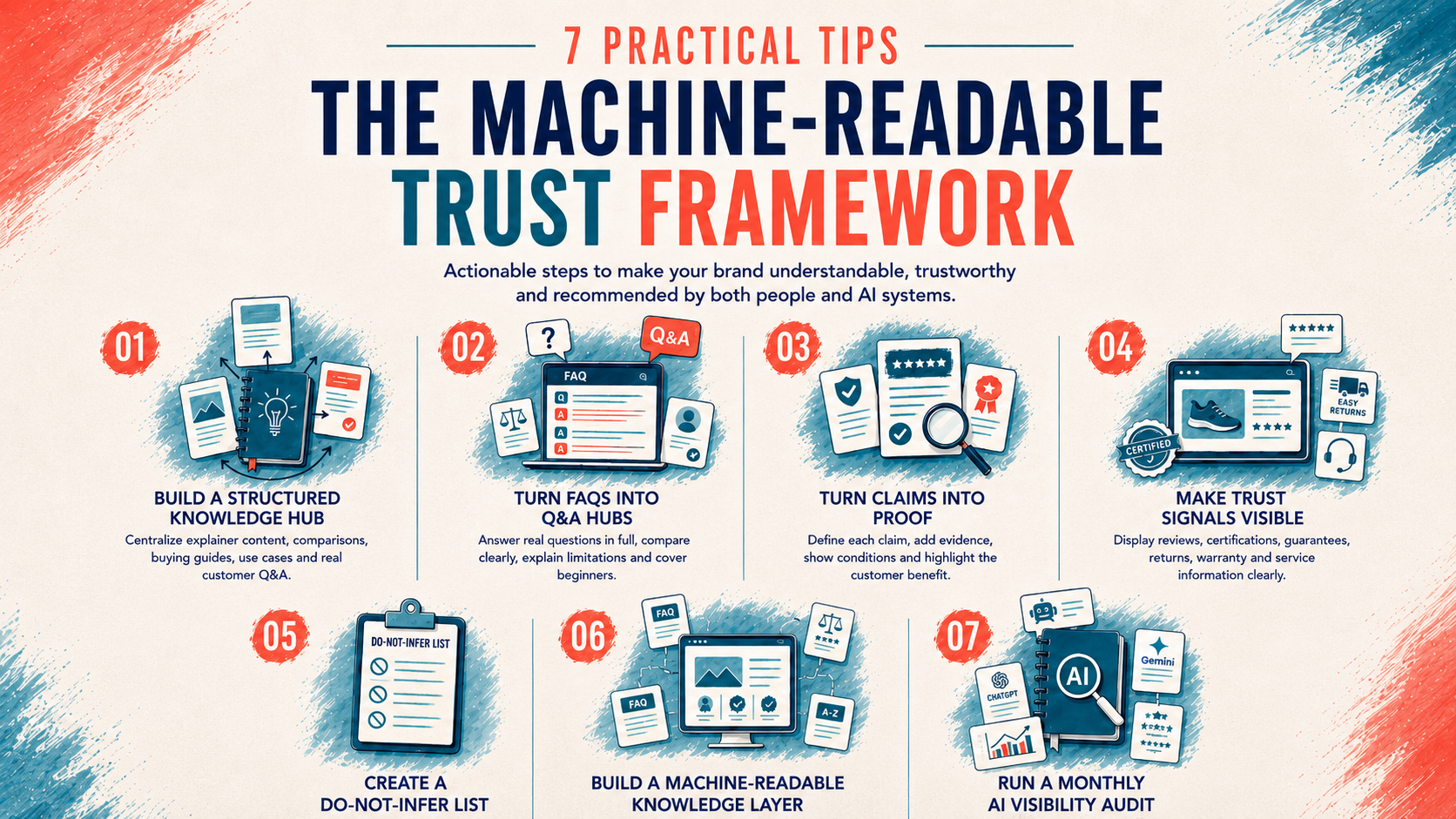
FAQs should become decision-support pages, not service leftovers
AI systems are built around questions, not only keywords. Brands should therefore write content around actual decision questions: Which product is best for which use case? What is the difference between product A and product B? What should I choose if I am a beginner? What should I avoid if I have a specific need or restriction? What is the best option for price-sensitive customers? Which product is not suitable for me?
Most FAQ pages are too thin, too generic and too defensive. They answer operational service questions, but they rarely support real buying decisions. In an AI-mediated journey, that is a missed opportunity.
A stronger Q&A layer should give full, useful answers. It should explain trade-offs, suitability, limitations and proof. It should not only help a customer after the purchase. It should help the customer, and the AI system assisting the customer, before the purchase decision is made.
Vague claims need to become proof-backed explanations
Many brands still rely on broad claims: sustainable, clean, premium, high-performance, clinically tested, science-backed, dermatologist-approved, long-lasting. These claims may work emotionally in campaign language, but they are weak signals for AI systems unless they are explained.
For each major claim, brands should be able to answer: What exactly does this claim mean? What proof supports it? Is there a certification, test, expert validation, customer review pattern or operational evidence? Where should the claim not be used? What would be an exaggeration?
Unsupported claims are easy to ignore, distort or flatten. Proof-backed claims are easier to understand and safer to recommend.
Trust signals need to be visible where machines can read them
Trust signals are becoming part of the new visibility layer. For commerce brands, relevant trust signals can include verified reviews, return policies, delivery promises, service guarantees, certifications, product testing, expert input, ingredient or material transparency, warranties, customer service availability, compliance information, brand history, media mentions and retailer or marketplace presence.
Many of these signals already exist somewhere in the organization. The problem is that they are often scattered across internal documents, campaign copy, legal pages, product detail pages, customer service answers or sales material. If they are fragmented, AI systems may not see them or may not connect them correctly.
Brands should therefore create a trust-signal inventory. Which trust signals matter in the category? Where are they currently visible? Are they present on product pages, category pages, FAQs, blog articles, structured data and marketplace listings? Are they consistent across channels? Are they supported by proof?
A "do not infer" list should become part of brand governance
LLM visibility is not only about being mentioned. It is about being represented correctly. Brands need to define clear inference boundaries. No medicalized claims without approval. No unsupported sustainability claims. No performance guarantees without evidence. No false compatibility assumptions. No price or availability assumptions. No suitability claims for sensitive customer needs. No exaggeration of reviews or test results.
This is especially relevant in categories such as beauty, health, nutrition, finance, mobility, electronics or anything where claims, safety, suitability and customer context matter. If the brand does not make its boundaries clear, AI systems may fill gaps in ways that are commercially attractive but legally or reputationally risky.
A "do not infer" list should not sit only with legal. It should become part of content governance, product data governance, agency briefings, customer service guidelines and AI readiness work.
AI visibility needs its own measurement logic
The old metrics still matter: impressions, clicks, rankings, ROAS, conversion rate, product feed completeness and marketplace ranking. But LLM visibility needs additional indicators.
Brands should start tracking AI answer visibility, product mention accuracy, claim consistency, usage-context coverage, trust-signal coverage, FAQ completeness, structured data completeness, share of key buying questions answered, misrepresentation risk and recommendation readiness.
A practical starting point is a monthly AI visibility audit. Ask ChatGPT, Gemini, Perplexity and other relevant systems the top buying questions in your category. Track whether your brand appears, how it is described, which competitors are mentioned, which claims are repeated and whether the answer is accurate.
The next brand advantage is clarity
Agentic commerce will not reward the loudest brand. It will reward the clearest one.
The brands that win will not only produce more content. They will create better context. They will make their products easier to understand, their claims easier to verify, their trust signals easier to detect and their boundaries easier to respect.
That is why the Machine-Readable Trust Framework is not just a content exercise. It is a commercial readiness exercise. It sits between brand, product data, content, legal, customer service, SEO, CRM and commercial leadership. It is not a campaign task. It is not only a technical task. It is a new layer of brand and growth infrastructure.
The next question for brands is no longer only: are we visible? It is: are we understandable enough to be recommended?